

Synthesia alternative for training: what to choose in 2026?
Synthesia, HeyGen and Colossyan generate videos with an avatar. Complement does something else: the learner talks to the avatar, interrupts it, and is assessed orally. Here is how to choose depending on what you are actually after.
Comparison published by Complement, updated September 2026.
One confusion comes up in every AI avatar comparison: tools that do different jobs end up in the same table. Synthesia, HeyGen and Colossyan are video generators — you write a script, an avatar speaks it, you get a file. Complement is a conversational learning platform — the avatar presents the content, answers the learner's questions and assesses them orally. The first produces an object, the second runs a session. Comparing their per-minute pricing therefore makes little sense; comparing what they let you achieve does.
| Criterion | Complement | Synthesia | HeyGen | Colossyan |
|---|---|---|---|---|
| Product type | Learning platform | Video generator | Video generator | Training-oriented video generator |
| Can the learner talk to the avatar? | Yes, in real time | No | No | No |
| Oral assessment | Yes | No | No | No |
| Quizzes and interactions | Open questions and MCQs, marked by the AI | Depends on the delivery platform | Depends on the delivery platform | Built-in quizzes and branching |
| LMS integration | LTI 1.3 (external resource) | Video export, SCORM on enterprise plans | Video export, SCORM on the Business plan | SCORM export |
| Avatar and language library | Dedicated avatars, English and French | Very large (240+ avatars, 160+ languages) | Very large | Large (120+ languages) |
| Pricing model | Pay per use: €5/hour/learner | Subscription by volume of minutes | Subscription by volume of minutes | Subscription by volume of minutes |
| Entry price | €5/hour (minimum purchase €50) | $29/month | ~$24/month | ~$27/month |
| Best for | Training that has to be understood and assessed | Video at scale, in many languages | Avatar realism, translation | Training video with quizzes |
About the data: public vendor pricing observed in September 2026 and subject to change — always check the current plans on synthesia.io, heygen.com and colossyan.com. Because the models are not of the same nature (subscription by volume of minutes versus pay per use), entry prices are not directly comparable.
Watching a video, or having a conversation
A video avatar reads a script written in advance. The result is the same for every learner, whatever their level, their questions or what they already understood. That is exactly the format of classic e-learning, with a talking head instead of a slideshow — which is why completion rates barely move.
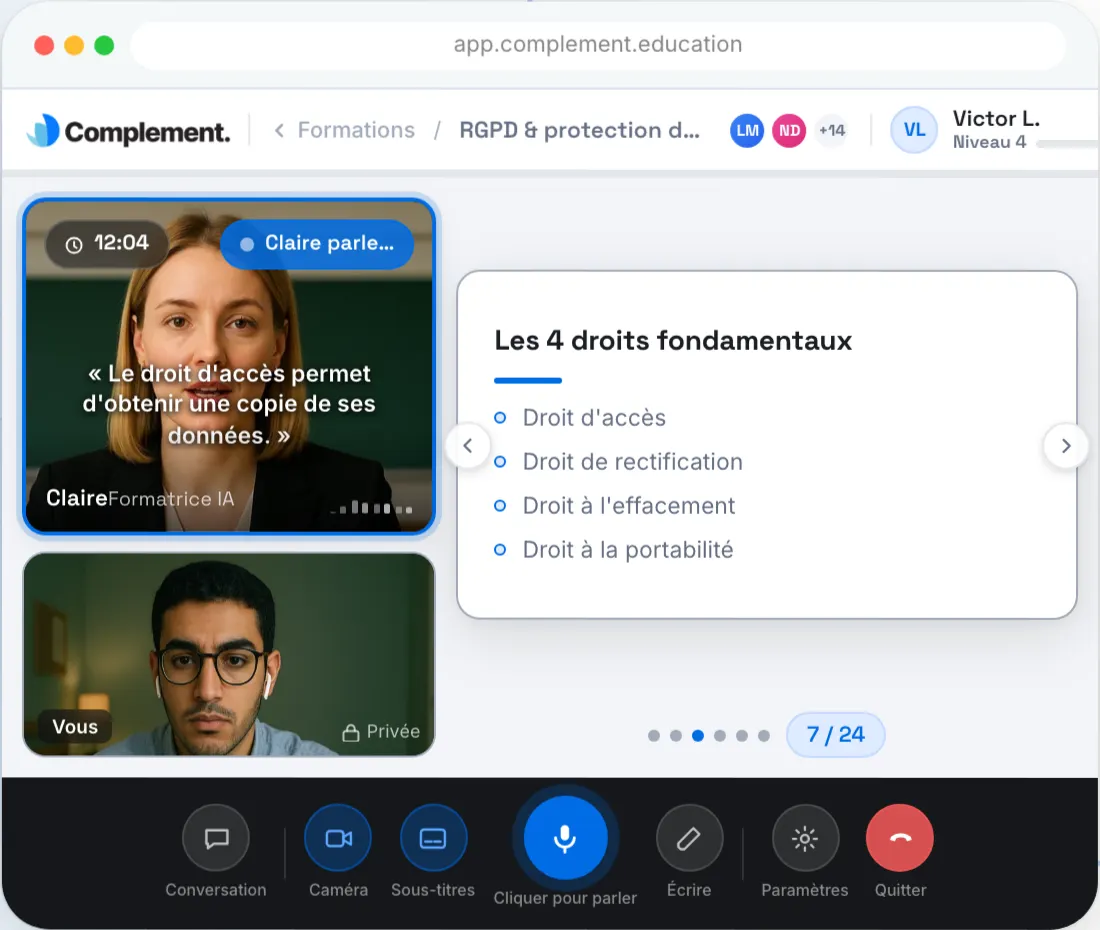
A conversational avatar works differently: the learner interrupts to ask for clarification, the avatar rephrases, goes back over a point, then asks a question the learner has to answer out loud. No two sessions are alike. That is what makes the exercise closer to sitting with a trainer, and what no video generator sets out to do.
SCORM on one side, LTI on the other, and why
Video generators produce a file that you import into your LMS, often wrapped in a SCORM package. The format is universal and works everywhere.
Complement cannot work that way. The avatar remembers the exchange from one slide to the next: it knows what the learner asked in chapter one when it assesses them in chapter three. SCORM, where each screen is independent, is incompatible with that architecture. The module is therefore added to your LMS as an external resource over LTI 1.3, and progress is reported back automatically. That is a real technical constraint, not a preference: if your LMS only supports SCORM, it is a blocker to check up front.
When Synthesia, HeyGen or Colossyan are the right choice
- Synthesia, when you need a lot of videos in a lot of languages. Its avatar library and language coverage have no equivalent, and for internal communication or a product video, an avatar that talks back adds nothing.
- HeyGen, when avatar realism and translation with lip sync are the core of the need, typically for marketing content.
- Colossyan, when you want to stay on video but with quizzes and branching, without moving to an enterprise plan.
- A classic authoring tool such as Storyline, if you need software simulations or complex visual interactions: see our e-learning authoring tools comparison.
In all of those cases, Complement is not the answer. We would rather say so here than let you find out after a trial.
When the problem is not producing, but getting people to learn
If your modules ship but few learners finish them, if you do not know what your learners actually understood, if your assessments come down to MCQs that can be passed without following the course: the video format is not the culprit, passivity is. An avatar that asks questions, listens to the answers and corrects them changes the nature of the exercise.
This matters most for compliance training, onboarding and higher education, where you have to be able to demonstrate that the knowledge has been acquired — not just that the module was opened.
Frequently asked questions
What is the best alternative to Synthesia?
It depends on what you are producing. For communication video or top-down training at scale, HeyGen and Colossyan are the most direct alternatives: same product category, comparable avatars. If your goal is for the learner to speak and be assessed, no video generator answers that need — it is a different category of tool.
What is the difference between a video avatar and a conversational avatar?
A video avatar reads a script written in advance: the result is a file, identical for everyone, that the learner watches. A conversational avatar answers in real time: the learner can interrupt it, ask a question, and the avatar assesses them orally on what they have just said. The first produces content, the second runs a session.
Can Synthesia assess learners?
Synthesia produces videos; assessment depends on what you distribute them in. Colossyan includes quizzes and branching in its standard plans, and HeyGen added SCORM export on its Business plan. In all three cases these are clickable questions around a video, not a spoken exchange with the learner.
Can a Complement module be imported into an LMS the way Synthesia allows?
Yes, but differently. Video generators export a file or a SCORM package that you import. Complement is added to your LMS as an external resource over LTI 1.3: the module stays hosted with us and progress is reported back automatically. That architecture is required because the avatar remembers the exchange from one slide to the next, which SCORM does not allow.
How much does Complement cost compared with Synthesia?
The models do not compare directly. Synthesia, HeyGen and Colossyan charge a monthly subscription tied to a volume of video minutes produced. Complement bills actual usage: €5 per hour per learner, with a minimum purchase of €50, or €6 per learner per month with the learner licence, with no commitment. You pay for the time a learner actually spends interacting with the avatar.
When does Synthesia remain the better choice?
When you need a lot of videos in a lot of languages, with a large library of avatars and voices: product videos, internal communication, top-down onboarding. That is what Synthesia does better than anyone, and a conversational avatar adds nothing to it.
Compare from another angle
Other angles of comparison, depending on the tool you use today.
See what an avatar that answers actually does
Fifteen minutes are enough to feel the difference between watching a video and having a conversation.