


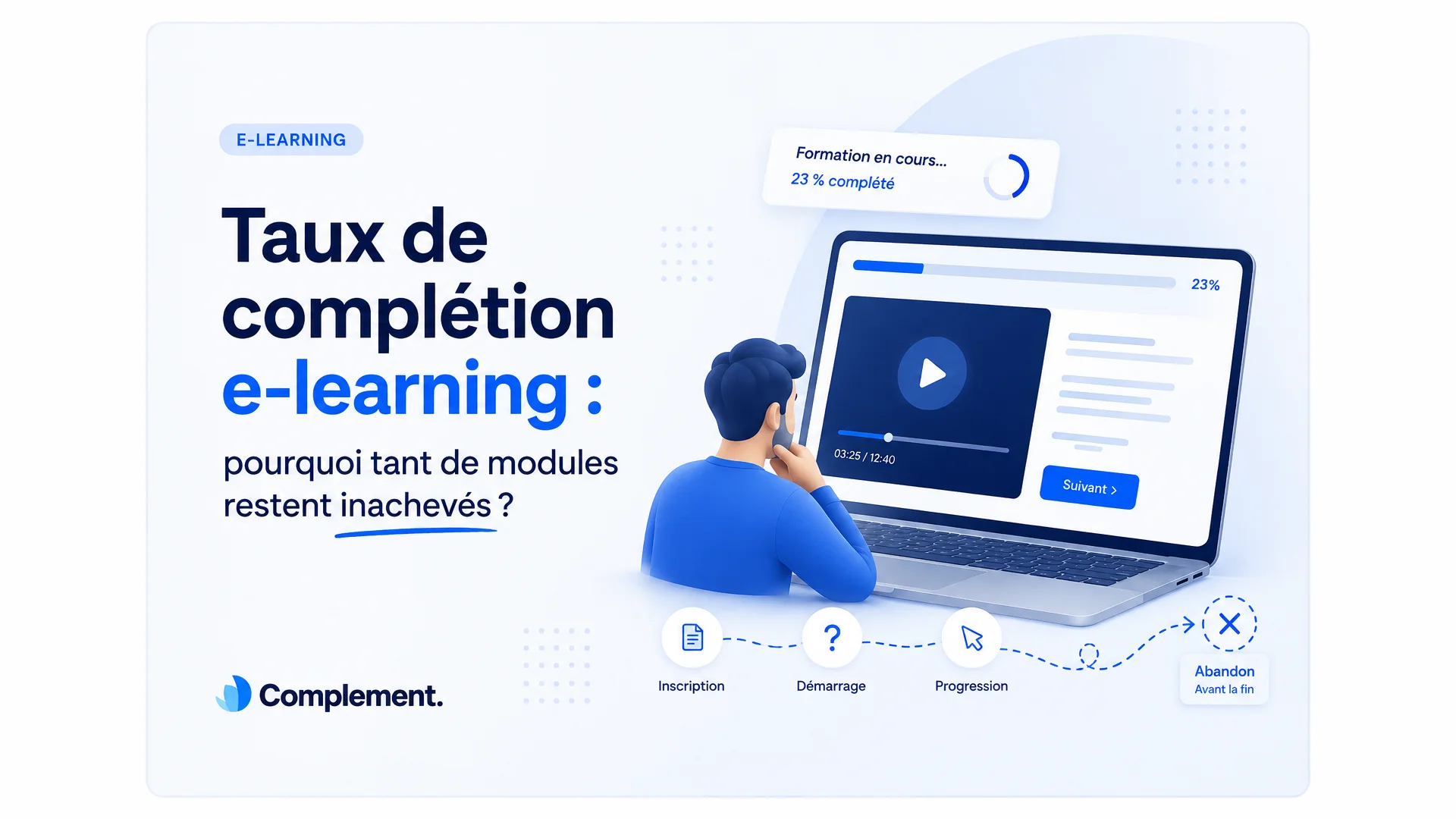
Let’s set the scene with a classic digital learning scenario. An employee launches a training module. A video starts. A few slides go by. They click "Next," answer two multiple-choice questions, and then a notification pops up.
They close the tab.
And most of the time, they never reopen it.
We tend to explain this drop-off by a lack of time or motivation. Yes, these factors exist. But they don't explain the whole reality.
Another question deserves to be asked: what was the module actually asking the learner to do?
In many classic e-learning courses, the answer comes down to a few verbs: watch, read, listen, click.
In other words, receiving information with very little action required from the learner.
However, much of the research on learning shows that receiving information does not produce the same level of engagement as having to use it, rephrase it, make a decision, or answer a question.
This may be where we need to look for part of the problem of modules that never get finished. A lack of interaction leads to a lack of motivation.
What is the real average completion rate for an e-learning course?
Let's start with a frequently cited figure.
In the world of digital learning, a completion rate of 20% to 30% is regularly presented as a market average.
The problem is that there is no large, independent database to confirm that 20%, 30%, or any other figure represents the average e-learning completion rate.
And for a simple reason: not all online training is the same.
Mandatory regulatory training, a free MOOC one signs up for out of curiosity, and a professional development module taken voluntarily by an employee cannot be compared directly.
Available studies instead provide an idea of the scale of the gaps.
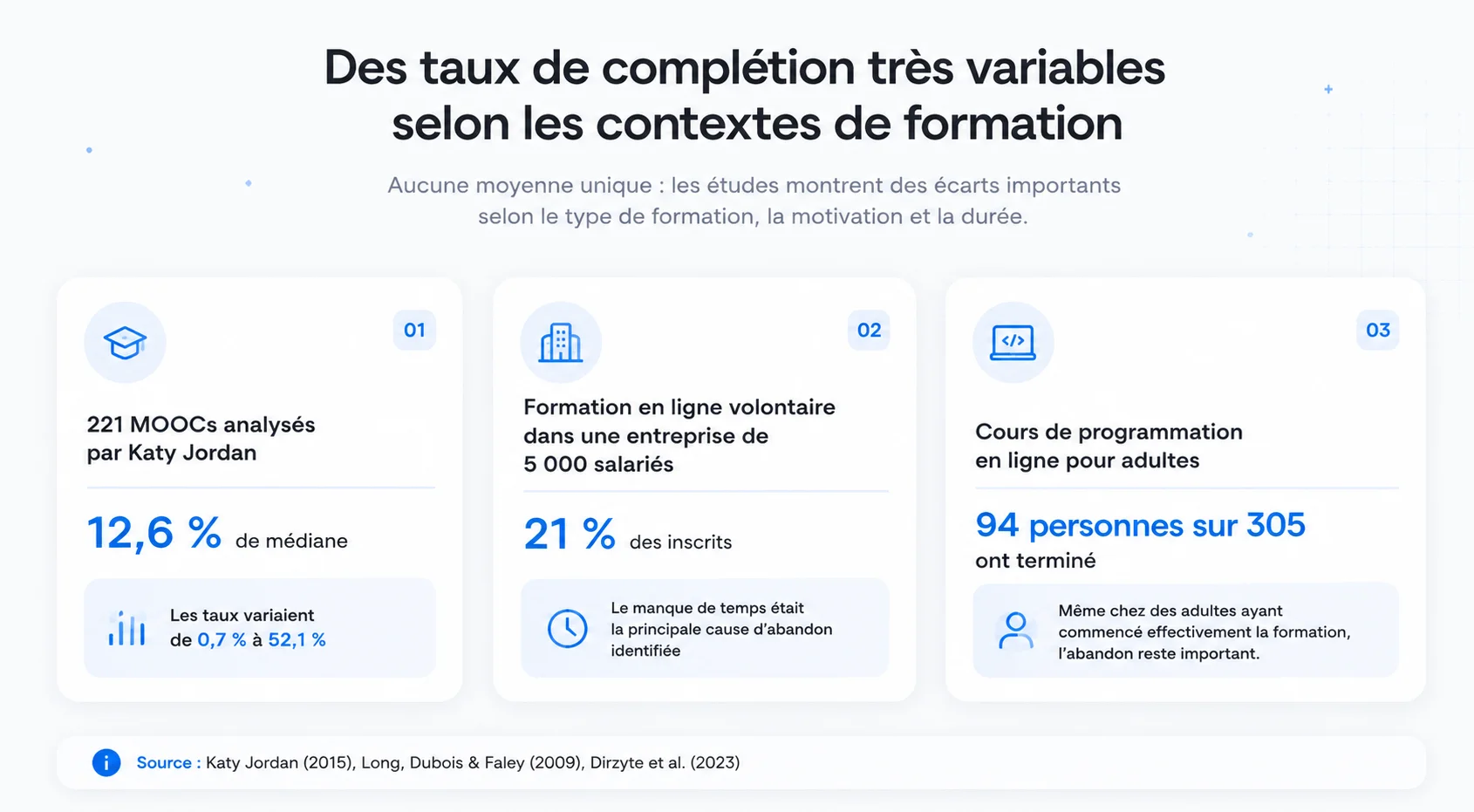
Katy Jordan’s study is particularly interesting. Across 221 MOOCs, she observed not only a median completion rate of 12.6% but also a very high dispersion of results. She also notes that longer training sessions tend to have lower completion rates and that the first two weeks play a critical role in engagement.
In another context, a study on a voluntary online training program offered to employees at an American company found that only 21% of registrants finished their training. The primary reason given for dropping out was neither the technology nor the quality of the content: it was a lack of time, both at work and at home.
More recently, a 2023 study on an adult programming training program reported that 305 people began the course, but only 94 finished it.
The completion rate depends heavily on initial motivation, whether the training is mandatory, its duration, level of difficulty, integration into work hours, and pedagogical design.
This makes general benchmarks useful for situating a problem, but insufficient for explaining it.
And finishing a module doesn't necessarily mean being engaged
We must add a second nuance.
A high completion rate is not automatically synonymous with pedagogical success.
An employee can finish a mandatory module by speeding through the videos, clicking until the final quiz, and retaking that quiz until achieving the required score.
Administratively, the training is finished.
Pedagogically, that’s another story.
The completion rate remains a useful indicator, especially when a significant portion of learners drop out along the way. But it primarily measures the fact that someone reached the end of a journey, not what happened cognitively during that journey.
This is where the issue of passivity becomes interesting.
The problem with many e-learning modules: the learner can remain a spectator
Watching a video obviously does not prevent learning.
Reading text doesn't either.
The problem arises when almost the entire path is built on this logic.
Video. Slide. Text. "Next" button. New video. Quiz.
The learner can go through several minutes of training without producing a single response themselves, without explaining what they understood, without applying a concept, and sometimes without making a single decision.
In the learning sciences, this distinction between receiving information and acting on that information is far from new.
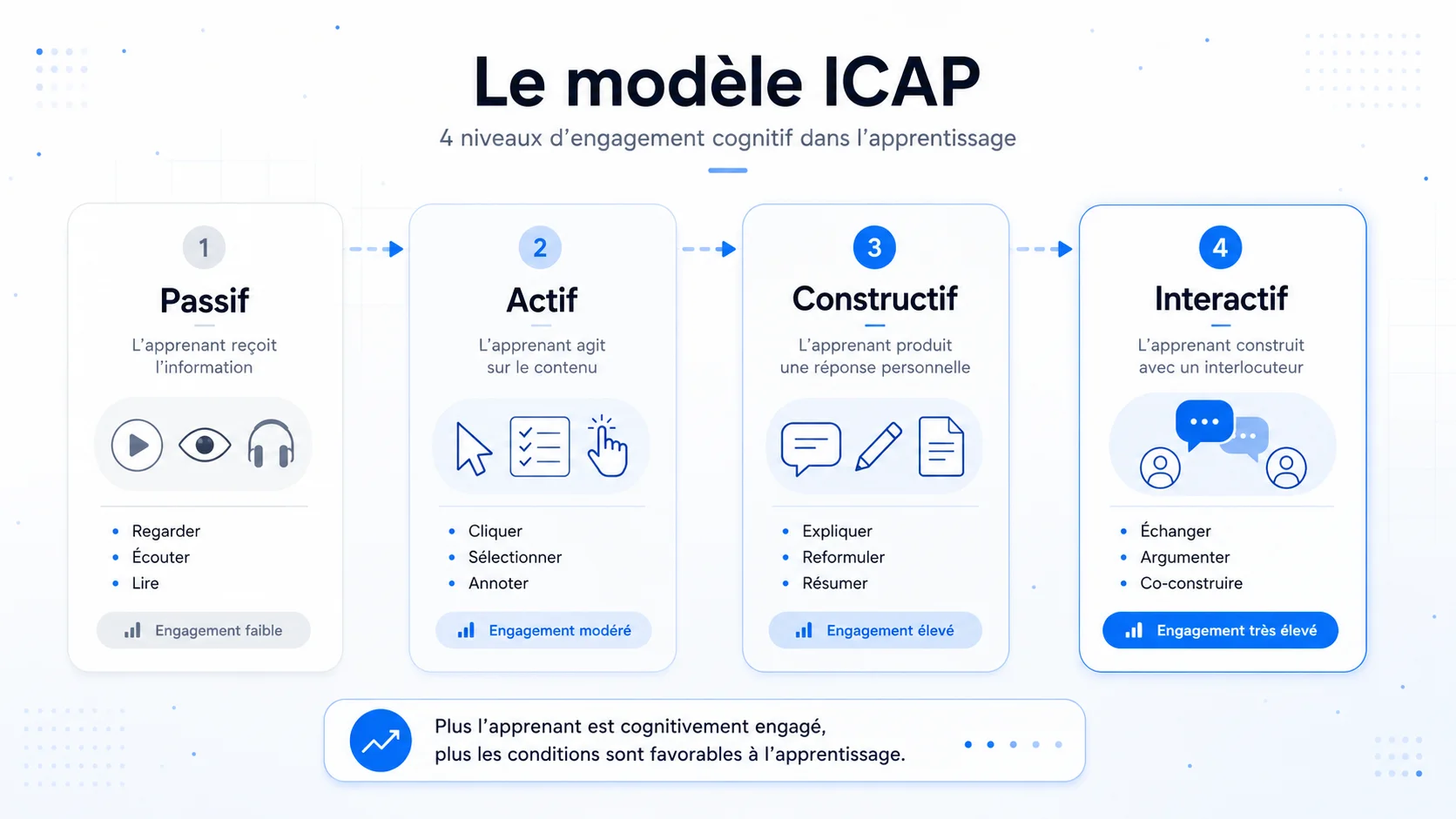
In 2014, researchers Michelene Chi and Ruth Wylie formalized the ICAP model, which distinguishes four levels of cognitive engagement: passive, active, constructive, and interactive.
In passive mode, the learner receives information, for example by watching or listening.
In active mode, they act on the content.
In constructive mode, they must produce something that goes beyond what is presented, for example, explaining a concept in their own words.
Finally, in interactive mode, several contributions respond to and build upon each other.
The central hypothesis of the model is simple: the more cognitively engaged the learner is in what they are doing, the more favorable the conditions are for learning.
And adding three buttons to a video does not automatically transform a passive experience into active learning.
That is the limit of tools built first for interactive visuals: a module built in Genially can be far more pleasant to browse without ever giving the learner something to produce.
What active learning really changes
Observations elsewhere in pedagogy help us understand why this distinction matters.
A meta-analysis published in Proceedings of the National Academy of Sciences gathered 225 studies comparing traditional lectures and active learning in STEM disciplines.
Students exposed to active learning methods achieved assessment scores about 6% higher on average. More importantly, students in traditional instruction were 1.5 times more likely to fail than those placed in active learning situations.
This study does not focus on corporate e-learning modules. Therefore, it does not allow us to claim that adding interaction to an LMS will mechanically increase its completion rate by X%.
However, it does highlight an important mechanism: asking the learner to do something with the knowledge changes the quality of learning.
A study focused on a professional development MOOC for teachers, for example, showed that interaction between the learner and the content predicted whether or not they completed the course.
Another study with 379 participants identified interaction with the instructor as a significant predictor of retention in the course.
This does not mean that passivity explains all dropouts.
Obviously, an employee can leave excellent training because a meeting starts in five minutes and never reopen it.
But a format in which they have nothing to do for long sequences makes dropping out particularly easy.
The more the learner is a spectator, the less the course creates immediate reasons to stay engaged. And therefore, the higher the chance of abandoning.
The lack of time is real. Passivity makes it even harder to overcome
This is an important point, because contrasting "lack of time" with "poor pedagogical format" would result in an artificial conclusion.
In real professional life, training competes with Slack, Teams, emails, meetings, client emergencies, and work to be completed.
The problem, therefore, is not just about capturing attention.
You must regularly give the learner a reason to reinvest it.
A question that requires an answer creates a small amount of engagement. A situation in which one must choose a reaction creates another. A request to rephrase forces one to verify what they have actually understood.
Personalized feedback provides a reason to continue.
Conversely, when a person knows they can remain silent and watch the next fifteen minutes of a module without having to do anything, another task can very easily take over.
The subject of engagement is therefore not just: "How do I make the content more attractive?"
The question becomes instead:
"How do I design training in which the learner regularly has something to think about, to say, or to decide?"
This is precisely what conversational learning can change
This is where we understand that the value of a conversational module is not just about making e-learning more modern. It is also not about adding an avatar to the screen.
The important change concerns the role of the learner.
In traditional linear training, the content is primarily pushed toward them. BUT, in a well-designed conversational experience, information flows in both directions.
The learner may need to answer a question before continuing. Explain a concept in their own words. Justify a choice. Ask a question when an element is unclear. React to a situation. Receive feedback and then correct their reasoning.
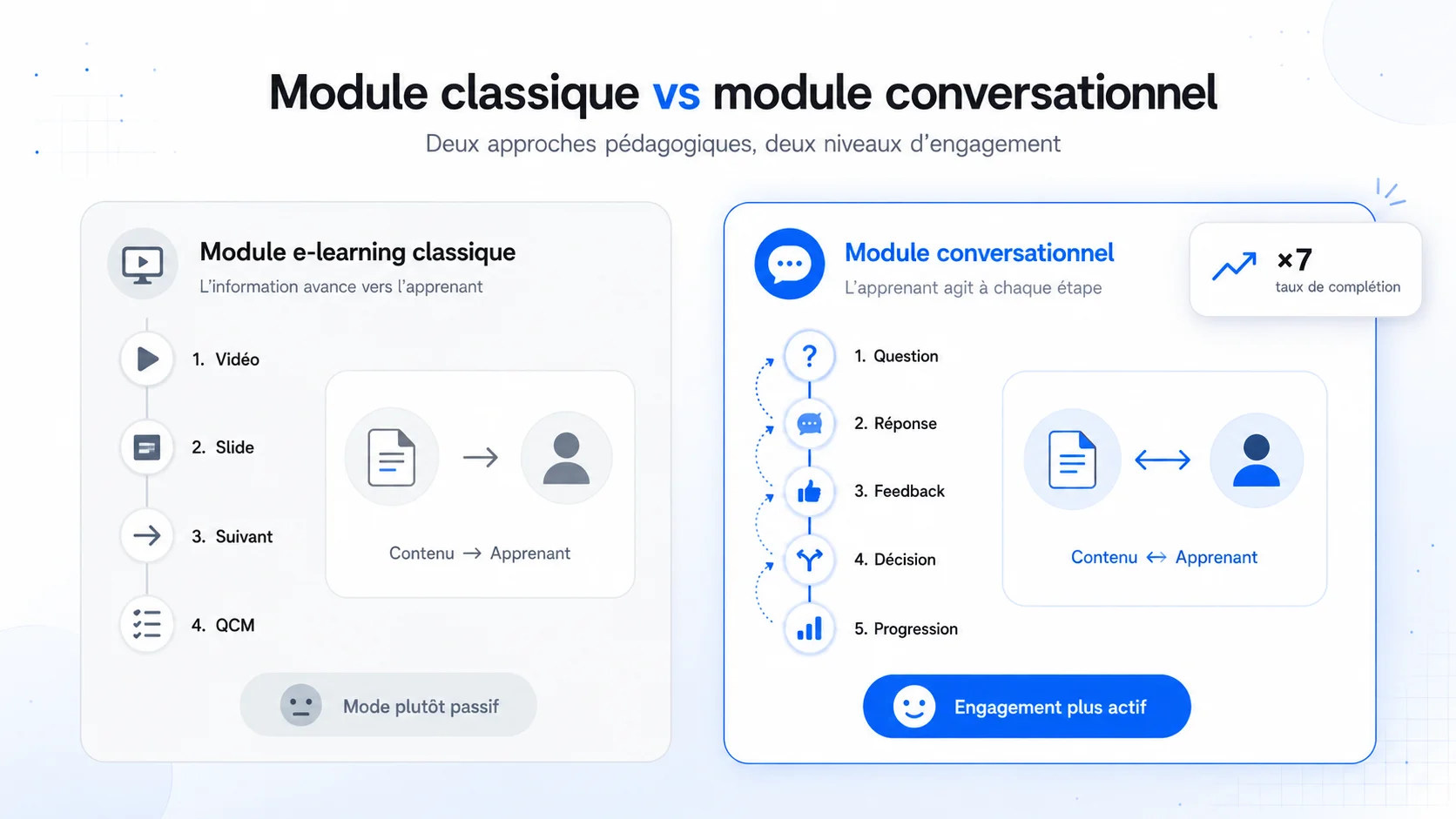
It becomes much more difficult to follow the module on "autopilot."
And this is probably where the pedagogical potential of conversational design lies: not in the conversation for its own sake, but in all the cognitive activities it naturally triggers.
To increase completion, you must look at what happens before the abandonment
A completion rate of 35% gives you one piece of information: 65% of people didn't reach the end.
But it doesn't say why.
To truly understand engagement, you must look at the journey more closely.
At what point do learners quit the module? How many actually start after receiving the invitation? How many respond when asked a question? At which stages do errors increase? Do learners return after a first session? Do they ask questions? Do certain sequences systematically lead to higher drop-off rates?
It is by going down to this level that the completion rate ceases to be merely a reporting figure and starts to become a pedagogical design tool.
Katy Jordan already observed in her analysis of MOOCs that the initial stages of the journey were particularly critical for engagement.
Waiting until the end of a module to discover that half of a cohort has disappeared is often waiting too long.
So the real challenge: moving from "content consumed" to "engaged learner"
For a long time, digitizing training mainly meant making its content accessible online.
That was already a considerable step forward.
But making information available and gaining the engagement necessary to learn it are two different problems.
The low completion rates observed in many online courses do not stem from a single cause. Available time, motivation, perceived relevance, course duration, and professional constraints all play a role.
But there is also a fundamental design issue.
Can we ask a learner to stay engaged for thirty minutes if, during those thirty minutes, we essentially ask them to watch?
Conversational design offers a possible answer to this limitation: regularly transforming reception into action.
Respond.
Question.
Rephrase.
Decide.
Make mistakes.
Receive feedback.
Try again.
This change seems simple. Yet, it profoundly alters the position occupied by the learner within the module.
In October: measuring what conversational design really changes
This is precisely the question we will explore in our next white paper:
"What really changes in learner engagement with a conversational module," to be published in October 2026.
The goal will not be to demonstrate that one format is "more engaging" simply because it is new or conversational.
We will instead seek to understand what changes concretely when the learner can no longer remain a spectator of their training: their participation, their answers, their questions, their moments of drop-off, their progress, and how they actually interact with the content.
Because, ultimately, the question may no longer just be about how many learners reach the last slide.
The real question is to know what they did to get there.