


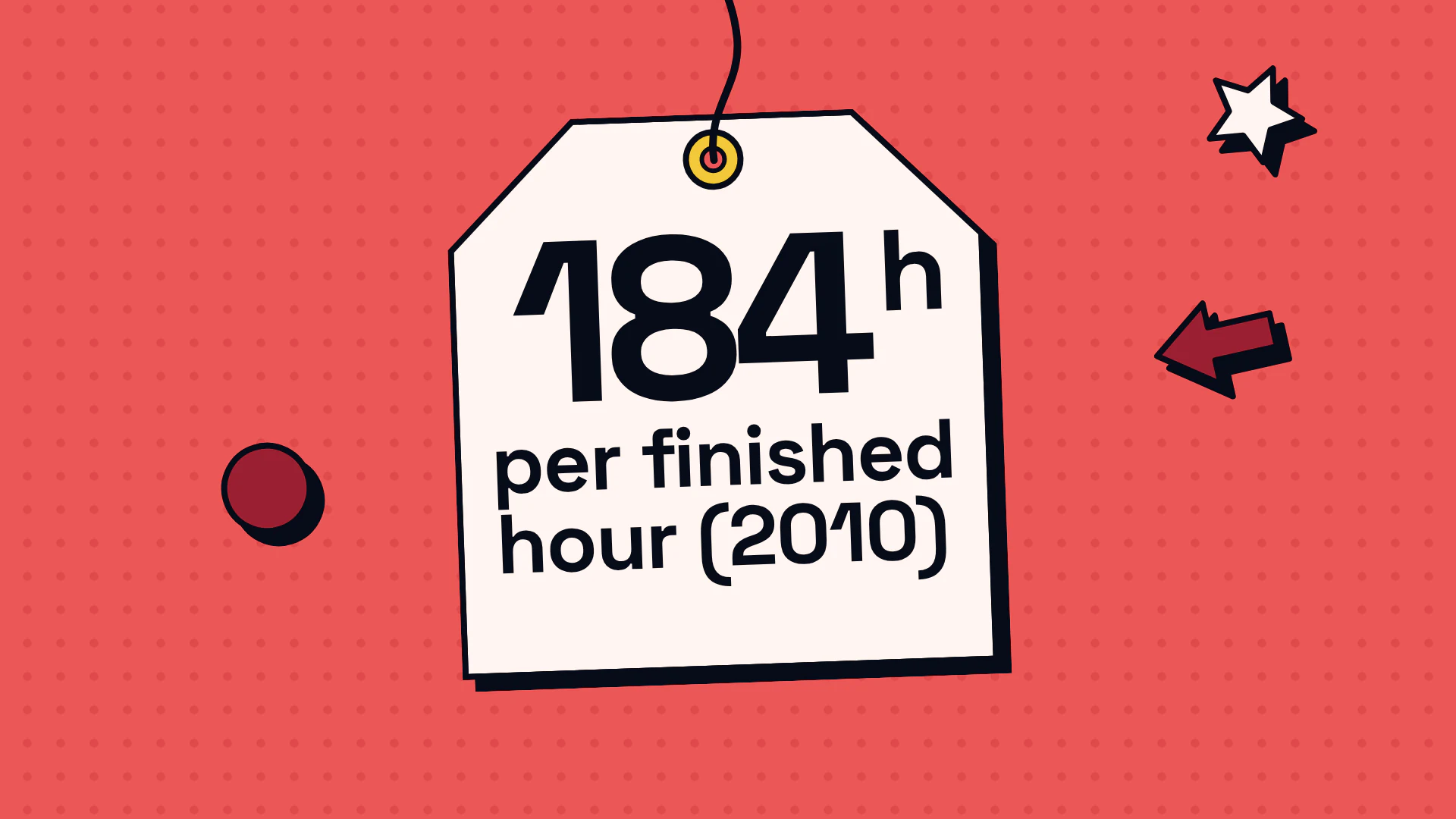
How long does it take to develop one hour of e-learning? The Chapman Alliance study (2010, 249 organizations) puts the average at 79 hours for basic e-learning, 184 for interactive and 490 for advanced. A 2017 ATD study reports lower averages. Interactivity drives the range, and every figure was reported by respondents, not measured.
How long does it take to develop 1 hour of e-learning, study by study?
Figures are hours of work per finished hour of training.
Chapman Alliance, 2010. The only study whose full figures can be read as text, and still the most detailed one published.
- Method: a survey of 249 organizations, representing 3,947 learning development professionals. Respondents gave a low, an average and a high figure.
- Instructor-led training (ILT): 43 hours on average (range 22 to 82).
- Level 1 e-learning (basic): 79 hours (range 49 to 125).
- Level 2 (interactive): 184 hours (range 127 to 267).
- Level 3 (advanced): 490 hours (range 217 to 716). Several respondents reported more than 2,000 hours.
- What it counts: time spent by all members of the development team.
ATD, 2017. ATD's 2017 update, by Robyn Defelice, follows the 2009 study she led with Karl Kapp.
- Method: a survey of L&D practitioners over a few weeks in summer 2017, with two questions. The article doesn't give the number of respondents.
- Level 1 (passive): 42 hours on average, according to EdgePoint Learning, which reports the ATD figures.
- Level 2 (limited interactivity): 71 hours on average, same source.
- Levels 3 and 4, and ILT: ATD publishes them in charts we couldn't read as text.
- Trend: 55% and 43% lower than in 2009, according to EdgePoint Learning.
Kapp and Defelice, 2009. We couldn't open the original ASTD article.
- Method: 47 respondents, 83% of them with a degree related to instructional technology or design, according to a RapidBI blog post.
- Highly interactive e-learning with multiple animations, built in a template: 136 to 324 hours, according to Karl Kapp, who co-led the study.
- What it counts: everything from analysis and design to development, implementation and evaluation.
ATD, 2021 and 2023. Two studies by Robyn Defelice.
- Method: 264 responses to an online survey in fall 2020, then 115 usable responses in 2023. In 2021, ATD asked for the time to develop a unit of training, because units are rarely an hour long. In 2023, it asked for the time to create a given training product.
- Results: minimum, maximum and average by type of product, published as charts only. The 2023 text says ILT takes less time to produce than e-learning, on average.
Why do the numbers vary so much?
Interactivity comes first. ATD defines level 1 as passive e-learning, where the learner "acts simply as a receiver of information". At level 4, real-time interactions "create life-like sets of complex cues and responses". Chapman uses three levels, ATD four: they don't map onto each other, so don't mix them.
Next, each study counts something different. Chapman counts the whole development team. Kapp's 2009 figures run from analysis to evaluation. In 2021, ATD asked respondents to count their time on the ADDIE model, excluding summative evaluation.
Finally, these are estimates, not time sheets. Chapman wrote its level definitions "to be relatively broad by design". In 2021 and 2023, ATD's average is the respondent's own estimate, not a calculation from the minimum and maximum. ATD also sees a likely factor in the drop since 2009: that year's survey was split up differently.
How long would a 20-minute module take?
Take a 20-minute module, as a fictional example. Twenty minutes is a third of an hour, so divide each ratio by 3 (rounded to the hour):
- Level 1, Chapman 2010: 79 ÷ 3, about 26 hours (range 16 to 42).
- Level 2, Chapman 2010: 184 ÷ 3, about 61 hours (range 42 to 89). Assuming a 7-hour working day, that's about 9 days.
- Level 3, Chapman 2010: 490 ÷ 3, about 163 hours (range 72 to 239).
- Levels 1 and 2, ATD 2017 (via EdgePoint Learning): 42 ÷ 3 = 14 hours, and 71 ÷ 3, about 24 hours.
This calculation assumes that time is proportional to length, and no study shows that. A short module still has fixed costs: analysis, review, integration. If the length itself is still open, see our article on how long a training session should be.
What does AI change, and what doesn't it change?
For a report released in August 2025, ATD surveyed 232 talent development professionals. Of those, 37% say AI tools have greatly reduced the time it takes to design a course. These are perceptions: no public study we found measures the time saved. And 20% of instructional designers don't use AI, mostly because they don't trust AI-generated content.
According to Complement, its AI authoring tool turns a prompt and your documents into one hour of training in 90 minutes, review included. That's the vendor's own figure, not an independent study, and it doesn't measure the same thing as the ratios above, which cover the whole project and the whole team. Complement's own guide still advises one hour of review per hour of generated training. Complement doesn't make the 90-minute claim for complex simulations, and its modules can't be exported to SCORM or any other format: they're shared by link or through LTI 1.3.
What AI doesn't remove: needs analysis, validation by the subject matter expert, and checking the accuracy of generated content, a concern ATD's survey also reports.
Estimate your own project
Pick the interactivity level you're aiming for and the matching ratio, with its source and year. Multiply it by the module's length in hours. Then compare the result with the time your team actually spent on a previous project: it's the only figure measured on your own work.
To test the 90-minute claim on your own material, start a 7-day free trial, no credit card required.