


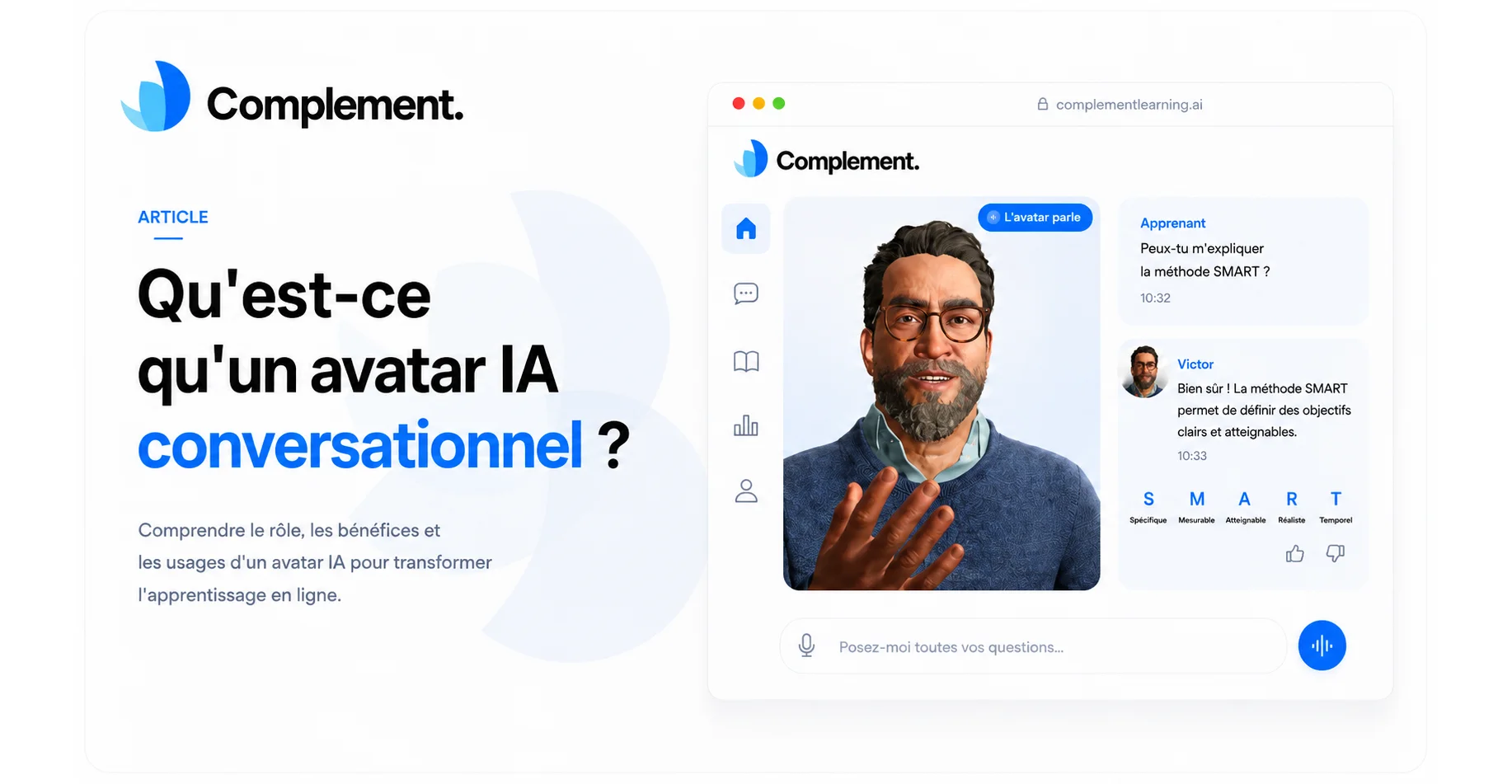
A conversational AI avatar is simply a virtual persona with whom you can have a real, two-way interaction.
It is often represented by a natural-looking 3D avatar with fluid speech and movements synchronized with its words.
As a result, it does more than just recite text or appear in a video. It can listen to a question, understand it, and respond directly to the person facing it in a completely natural exchange.
In a training context, this allows for a virtual trainer capable of explaining a subject, answering a learner’s questions, or reacting to their responses.
But to fully grasp what this changes, we must first distinguish between a few terms that are often confused.
Virtual avatar, AI avatar, conversational avatar: what is the difference?
A virtual avatar is simply the digital representation of a person or character. This could be a video game character, a profile picture, or a digitally generated presenter.
An AI avatar goes a bit further. Artificial intelligence can, for example, generate its voice, its movements, or synchronize its lips with a script.
This is notably what we see in some AI-generated videos: you write a script, an avatar recites it to the camera, and the video is then distributed.
In this case, the avatar speaks, but it does not actually dialogue with the person watching the video.
That is where the conversational AI avatar comes in.
The learner can ask it a question, request a rephrased explanation, or answer a question it just posed. The avatar then reacts based on what was just said.
The difference is quite simple: a conversational avatar does more than just speak; it engages in an exchange.
How is this different from a chatbot?
One might ask: why not just use a chatbot?
Technically, both can use the same artificial intelligence models and be capable of understanding a question or producing a relevant response.
What really changes is the way the user interacts with the AI.
A chatbot is generally a space where you go to ask a question. You type a message, it responds, and then you potentially continue the discussion.
The conversational avatar can have a much more active presence in the experience.
In training, for example, it can:
- present the course orally;
- ask questions itself;
- listen to the learner’s answers;
- respond when a concept is not understood;
- provide feedback;
- then naturally continue the training.
We are no longer just looking for an answer from an AI. We are following a training program with one.
What does an AI avatar look like at Complement?
This is exactly how we use avatars at Complement.
The idea is not simply to add a face to artificial intelligence. The avatar takes a direct part in the training.
Let’s take a very simple example.
A learner is taking a GDPR training course. The avatar explains the principle of the right to data portability.
At that point, the learner can interrupt and ask:
“I don’t quite understand the difference with the right of access.”
The avatar can then respond directly, rephrase its explanation, and resume the training.
But the conversation also works in the other direction.
A few minutes later, the avatar can ask:
“Can you explain in your own words what the right to portability allows?”
The learner responds, either orally or in writing, depending on the chosen format.
The avatar then analyzes their response. If an important element is missing, it can point it out and provide additional explanation. If the answer is correct, it can confirm it before moving on.
At Complement, the avatar combines several roles: it presents, questions, listens, responds, and provides feedback.
The goal is also to make the exchange as natural as possible. The avatars have a realistic face and voice, with diction designed to feel more like a conversation than the mechanical reading of a script.
What does this change for training?
The main change is ultimately quite simple.
In a traditional video or e-learning module, the content continues even if the learner hasn’t understood something.
With a conversational avatar, they can intervene.
They can ask for an additional example, have a term clarified, or ask a question that wasn't necessarily planned when the course was created.
And the avatar can also regularly check what has been understood.
Therefore, two people can follow the same training but not necessarily have the exact same conversation. Furthermore, information retention is often much better thanks to the learner's participation and active recall.
This is likely the best way to define a conversational AI avatar applied to training: a virtual trainer capable of presenting content, but above all interacting with each learner while they learn.
To discover more about the possibilities of this technology, visit our page dedicated to AI Avatar vs. Traditional E-learning Video.
Do you want to see how a Complement avatar actually engages with a learner? Book a demo